

The 1% Rule: A Practical Guide to Risk Management for Indian Retail Traders
Most Indian retail traders spend months perfecting technical indicators only to see a single volatile session in the Nifty or Bank Nifty wipe out their entire month’s progress. This “one step forward, two steps back” cycle is emotionally draining and financially unsustainable for those trying to build a career in the markets. This guide explains risk management in day trading India clearly and shows what to evaluate next.
The reality is that professional success isn’t about predicting the next market move with 100% accuracy; it is about surviving the trades you get wrong. By adopting a mathematical boundary known as the 1% rule, you shift your focus from chasing profits to protecting the capital that allows you to stay in the game.
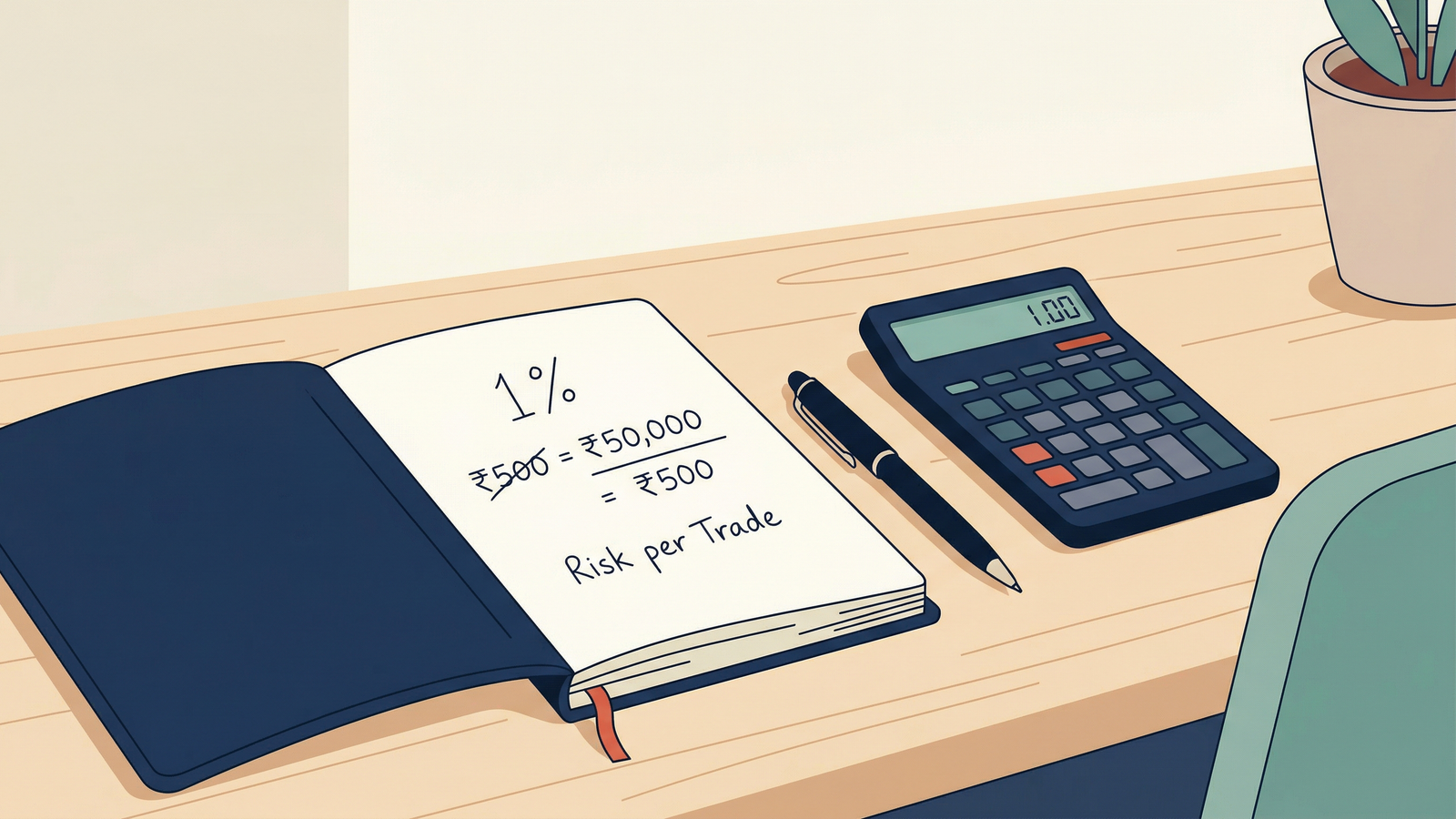
Implementing this disciplined framework ensures that no single loss can derail your long-term growth. You will gain the psychological freedom to execute setups without fear, knowing that your account is mathematically shielded against the volatility that typically liquidates 90% of F&O participants.
Table of Contents
- What Is the 1% Rule in Day Trading?
- Why 90% of F&O Traders Lose Money
- Position Sizing vs. Stop Loss
- How to Calculate Position Size
- 5 Non-negotiable Risk Management Rules
- Quick Summary
- FAQ
What Is the 1% Rule in Day Trading?
The 1% rule is a strict mathematical boundary stating that you should never risk more than one percent of your total trading capital on any single trade. If you have a trading account with ₹1,00,000, your maximum acceptable loss on a given setup is exactly ₹1,000. This parameter forms the foundation of professional risk management in day trading India, where market dynamics require a “defense-first” mindset.
Capital preservation must always come before profit generation, a core philosophy taught in any legitimate stock market course offering a structured learning path.
By capping your downside, you remove the emotional panic that accompanies sudden market reversals. This approach guarantees survival during inevitable losing streaks. Even if you encounter a sequence of 20 consecutive losses, you would still retain over 80% of your original capital.
Why 90% of F&O Traders Lose Money
The Securities and Exchange Board of India (SEBI) consistently reports that nine out of ten retail traders in the F&O segment lose money. While beginners often blame flawed entry signals or “market manipulation,” the primary driver of failure is the complete absence of risk management.
When traders ignore position sizing, a single unpredictable swing can decimate weeks of steady gains. Survival relies on capital preservation, not on predicting every market movement.
Taking oversized positions triggers a destructive psychological cycle. When a heavily leveraged trade moves against you, the immediate emotional response often leads to revenge trading—doubling down to recover losses. This behavior is exactly what structured learning programs like a professional trading course aim to eliminate.
Position Sizing vs. Stop Loss: The Decision Framework
A stop loss order protects your capital from a catastrophic reversal, but it is only half of the equation. A stop loss dictates where you will exit, while position sizing dictates how much you will lose.
| Feature | Stop Loss | Position Sizing |
|---|---|---|
| Primary Function | Exit point based on price action | Controls financial exposure |
| Focus | Where trade fails | How much to trade |
| Risk Control | Limits losses | Keeps loss within 1% |
Professionals always combine both. First define your stop loss, then calculate position size accordingly.
How to Calculate Your Position Size
Calculating position size requires three variables: total capital, entry price, and stop loss.
Formula:
Position Size = (Total Capital × 0.01) / (Entry Price - Stop Loss)
Practical Example:
- Capital: ₹10,00,000
- Risk (1%): ₹10,000
- Entry: ₹500
- Stop Loss: ₹480
- Risk per Share: ₹20
- Position Size: 500 shares
This simple rule ensures long-term profitability even with a lower win rate. For traders serious about execution, structured programs like a price action trading course India help apply these concepts in real-time.
5 Non-negotiable Risk Management Rules
- Respect the Stop Loss: Never move it further.
- No Averaging Down: Do not increase losing positions.
- Avoid Revenge Trading: Stop after hitting daily loss limit.
- Scale Gradually: Increase risk only after consistency.
- Audit Trades: Track every trade and review mistakes.
Quick Summary: What Matters Most
The 1% rule is the backbone of successful trading. It shifts your mindset from profit-chasing to capital protection.
- Risk only 1% per trade
- Always combine stop loss with position sizing
- Focus on survival, not prediction
- Build discipline before scaling capital
FAQ
What Is the Most Effective Risk Management Strategy?
The 1% rule ensures that no single trade can significantly damage your capital.
Why Do Most Traders Fail in F&O?
Due to high leverage, poor discipline, and lack of risk management.
Can You Be Profitable With Low Accuracy?
Yes. With proper risk-reward (1:2), even a 40% win rate can be profitable.
Should Beginners Trade F&O?
No. Start with equity markets and master risk management first.
How Important Is Position Sizing?
It is the most critical factor in long-term survival and profitability.
Next Step
Join the Fast & Fortunate (FAF) course to master professional trading execution. Use the frameworks above to pressure-test your strategy and build a disciplined, math-driven trading career.